
1300 85 1919
Call us today!
Australian Design Solar · Commercial & large home systems
A 20kW solar system can be a practical option for Australian businesses and larger homes with substantial electricity consumption. Australian Design Solar designs rooftop solar around your energy use, roof conditions, electrical supply and future plans.
Compare 20kW solar system installation prices, likely electricity production, panel numbers, network approvals and compatible solar batteries before making a decision. We welcome enquiries in Sydney, Melbourne, Brisbane, Adelaide, Canberra and surrounding areas.
Get a tailored 20kW quoteCall 1300 85 1919A 20kW installation is individually quoted. System suitability and service availability are confirmed for your property.
A 20kW solar system has approximately 20 kilowatts (20,000 watts) of rated solar-panel capacity. The panels produce DC electricity when sunlight is available, and an inverter converts it into usable AC electricity.
The rating describes the panel array, not how much electricity is produced every hour. Actual energy production is measured in kilowatt-hours (kWh) and changes with sunlight, weather, temperature, orientation, shading and system losses.
A quotation should specify the panel array capacity, panel count, inverter capacity, monitoring equipment and installation scope. A 20kW inverter paired with a larger array is not the same specification as a 20kW panel array.
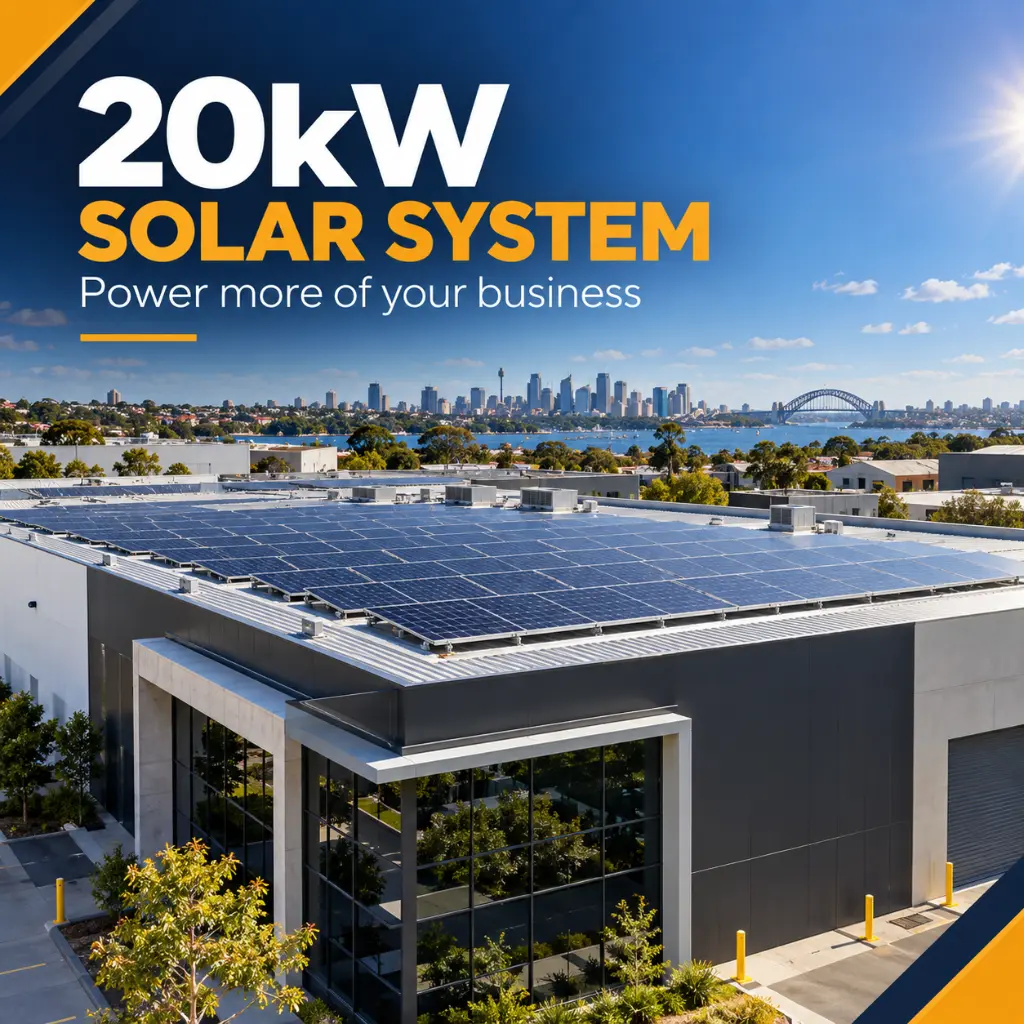
The installed price of a 20kW solar system in Australia depends on the selected panels and inverter, mounting method, roof access, switchboard condition, electrical cabling, network requirements and any battery equipment. A fixed national price can be misleading because commercial and high-demand residential installations differ substantially.
Australian Design Solar provides a site-specific written quotation rather than promising one installation price for every building. Ask for the total payable amount, GST treatment, equipment models, applicable incentives, exclusions and warranty terms.
Panel brand, module wattage, inverter specification and monitoring features influence equipment cost.
Roof material, pitch, height, structural condition, mounting design and safe access influence labour and materials.
Supply phases, switchboard changes, export controls, network approvals and metering may affect the final scope.
Panel quantity is determined by the wattage of the selected modules. Modern panels can deliver different rated outputs, so a system may have fewer higher-wattage panels or more lower-wattage panels.
| Panel wattage | Example quantity | Total panel capacity |
|---|---|---|
| 440W | 45 | 19.8kW |
| 450W | 44 | 19.8kW |
| 500W | 40 | 20.0kW |
| 550W | 36 | 19.8kW |
These examples illustrate the calculation rather than the components of a specific package. Your proposal should identify exact panel models and total array capacity.
The roof-area requirement depends on panel dimensions, orientation, setbacks, access pathways, obstructions and roof shape. For example, 40 panels with a surface area of 2.2m² each occupy 88m² of panel surface alone; installation space will generally be greater.
A 20kW rooftop system can generate a substantial amount of electricity, but there is no reliable single daily output figure for every Australian property. Location, season, weather, orientation, shading and inverter losses all matter.
For illustration, a net yield of 3.5–4.5kWh per installed kW per day would correspond to roughly 70–90kWh per day for a 20kW array. This is an assumed calculation, not a prediction or performance guarantee. A professional design should provide location-specific monthly and annual estimates.
For businesses, electricity generated during trading hours can be particularly valuable when it replaces power otherwise purchased from the grid. Compare the estimated generation profile with your actual operating hours and consumption data.
Businesses with suitable roof area and meaningful daytime loads can assess a 20kW system against machinery, lighting and operating hours.
Air conditioning, refrigeration, lighting and office equipment may provide daytime demand that aligns with solar generation.
Homes with EV charging, pools, ducted air conditioning or other substantial demand may consider a larger solar system where roof and network conditions allow.
For business-specific design and installation considerations, explore our commercial solar solutions. Homeowners can compare our residential solar installation services.
A 20kW solar array does not automatically require a 20kWh battery. kW measures rated power, while kWh measures stored energy. Battery capacity should be chosen based on surplus solar generation, evening demand, usable storage capacity and backup priorities.
Adding a compatible battery can help shift some daytime solar energy into the evening. For businesses, it may also be worth examining storage against the operating schedule and tariff structure. The financial case must be assessed using actual energy data.
Backup during blackouts is not automatic. The selected inverter, battery and electrical design must support it; confirm supported circuits, power limits and any additional equipment in your quote.
Explore our solar systems with battery storage and Sungrow solar battery options.

A 20kW solar proposal should consider the existing electrical supply and local electricity distributor requirements before equipment is selected. A large solar inverter may require a suitable three-phase arrangement, but the applicable rules depend on the site and network.
Network connection approval and export permission are different. Your property may be allowed to install a system while facing a limit on how much electricity can be exported to the grid. Export-control settings, monitoring and other equipment may be needed.
Ask the installer to check your supply configuration, switchboard, inverter compliance, metering and any necessary network applications. Where the roof is leased or shared, property-owner approval may also be required.
| Solar size | Who may consider it? | Key assessment |
|---|---|---|
| 10kW | Higher-use homes | Household consumption and roof space |
| 13kW | Larger homes | Future electrification and battery plans |
| 20kW | Large homes and smaller commercial sites | Daytime demand, electrical supply and roof suitability |
| 30kW | Businesses with greater demand | Interval data, roof area and network conditions |
| 50kW | Larger commercial premises | Higher loads, approvals and installation coordination |
Bigger is not always better. The best financial result depends on how much solar electricity is used on site, export conditions and the installed cost.
Compare 10kW solar systems, 13kW solar systems, 30kW commercial solar and 50kW solar systems.
Ask which items are included, excluded or separately charged. Roof repairs, structural assessments, switchboard upgrades and battery backup should never be assumed to be part of a basic package.
Eligible solar installations may receive an upfront financial benefit through Small-scale Technology Certificates (STCs), subject to the scheme rules and the system’s eligibility. The amount depends on factors including installation date, location, system size and applicable deeming arrangements.
Commercial installations may also raise business-specific tax and accounting questions. Treatment depends on the purchaser, ownership structure and current law; discuss these with a qualified Australian tax adviser rather than assuming a particular deduction.
Your quote should clearly show any incentive assumptions, GST treatment and total payable cost. Network approval and installation eligibility should be confirmed before commitments are made.
Australian Design Solar welcomes enquiries for 20kW solar installations in Sydney, Melbourne, Brisbane, Adelaide and Canberra, as well as surrounding areas where service is available.
Sydney enquiries include Norwest, Castle Hill, Bella Vista, Baulkham Hills, Kellyville, Blacktown, Parramatta, Penrith, Rouse Hill and neighbouring suburbs. In other cities, provide your postcode, electricity bills and property details so the team can confirm installation availability and next steps.
For commercial buildings, please also share operating hours, site access requirements, whether the property is leased and any upcoming roof or electrical works.
Tell us your postcode, electricity usage, roof type and whether you are planning battery storage.
We review consumption, roof layout, shading, electrical supply and any network constraints.
Compare the specified panels, inverter, generation assumptions, installation scope and total cost.
Required permissions and installation arrangements are coordinated for the agreed project.
Review system operation, monitoring access, warranty documents and ongoing support information.
Discuss battery upgrades, EV charging or changing electricity demand before expanding the system.
The installed cost depends on equipment, roof conditions, electrical work, network requirements and any battery storage. Australian Design Solar provides tailored quotes rather than one universal 20kW price.
For example, 40 panels rated at 500W equal 20kW. Different module wattages produce different panel counts and exact total capacities.
Output depends on location, season and system design. An illustrative yield of 3.5–4.5kWh per installed kW corresponds to 70–90kWh daily, but this is not a site forecast.
The requirement depends on panel dimensions, roof geometry, setbacks, obstructions and access. Forty panels occupying 2.2m² each cover 88m² of panel surface, excluding extra layout space.
It may suit a large home with substantial electricity demand, adequate roof space and suitable electrical and network conditions.
The supply and network rules must be checked for your property. Do not assume the proposed inverter can connect to your existing supply.
Yes, subject to compatibility and site assessment. Battery capacity should be selected from electricity use, available surplus solar and backup needs.
No. A 20kW solar system describes rated panel power; a 20kWh battery describes an amount of stored electrical energy.
Standard grid-connected solar normally stops during an outage. Backup requires compatible equipment and a specifically designed configuration.
Eligible installations may benefit from STCs, subject to scheme rules. The quote should identify any incentive assumptions and the final payable amount.
Timing depends on site assessment, network approvals, roof access, equipment availability and the agreed installation scope.
Share your postcode, electricity bills, usage pattern, roof details, existing solar information and any battery or EV charging plans.
Compare solar equipment, installation requirements and battery options with Australian Design Solar. Tell us about your property so we can recommend the next steps for a suitable system.
Request a free solar quoteOpen quote pagePrefer to speak with our team? 1300 85 1919.