
50kW Solar System Australia: Price, Output & Commercial Installation Guide
A 50kW solar system is a substantial commercial solar solution for Australian businesses looking to generate more electricity on-site and reduce reliance on grid electricity during operating hours.
Rather than selecting commercial solar based on system capacity alone, a 50kW installation should be designed around your business electricity consumption, operating hours, available roof area, electrical infrastructure and network requirements.
Get a 50kW Solar System Quote
Tell us about your business premises, postcode and electricity requirements so we can assess whether a 50kW commercial solar system suits your site.
✓ Solar system sizing guidance
✓ No-obligation quotation
What Is a 50kW Solar System?
A 50kW solar system is a photovoltaic system with approximately 50 kilowatts of rated solar-panel capacity. It is substantially larger than a typical residential installation and is commonly assessed for commercial premises with meaningful daytime electricity demand.
A properly designed 50kW commercial solar installation can generate electricity while a business is operating, allowing part of the site’s electricity demand to be supplied directly from rooftop solar instead of purchasing all electricity from the grid.

50kW Commercial Solar for Australian Businesses
A 50kW commercial solar system can provide a substantial source of on-site renewable electricity for businesses with consistent daytime energy consumption.
Commercial solar works particularly well when electricity demand occurs during daylight hours, because solar generation can be used directly by equipment, lighting, air conditioning, refrigeration, machinery and other business loads.
The system should be designed around your site’s actual energy requirements rather than simply installing as many panels as possible.
Request a 50kW Solar AssessmentHow Much Does a 50kW Solar System Cost in Australia?
There is no single installed price that accurately applies to every 50kW commercial solar project. Pricing depends on the solar panels, inverter configuration, mounting system, roof design, electrical infrastructure, site access, network requirements and the amount of engineering or project work required.
A straightforward installation on a suitable commercial roof may cost less than a project requiring extensive switchboard upgrades, difficult access, multiple roof areas, structural considerations or complex network connection work.
| Cost Factor | How It Can Affect a 50kW Project |
|---|---|
| Solar Panels | Panel wattage, efficiency, manufacturer, warranty and module quantity influence equipment and installation costs. |
| Commercial Inverter | Inverter brand, capacity, phase configuration and system architecture influence the final project design. |
| Roof Type | Metal, concrete and other commercial roofing types can require different mounting methods. |
| Site Access | Building height, roof access, lifting requirements and workplace restrictions can affect labour and project coordination. |
| Electrical Work | Switchboard condition, cable routes, protection equipment and existing electrical infrastructure can affect project cost. |
| Network Requirements | Connection and export requirements can influence inverter settings, system design and approval processes. |
How Much Electricity Can a 50kW Solar System Generate?
A 50kW solar system may generate approximately 150–220kWh of electricity per day under suitable conditions, although actual production varies significantly according to location, season and system design.
Annual and daily output should therefore be modelled for the specific commercial property rather than treated as a guaranteed fixed amount.
Location
Solar irradiation differs across Sydney, Melbourne, Brisbane, Adelaide, Canberra and other Australian regions.
Roof Orientation
Panel orientation affects when the system generates electricity and how production aligns with business operating hours.
Shading
Nearby buildings, rooftop equipment, trees and other obstructions can reduce available solar generation.
Panel Efficiency
Module efficiency and system design influence how effectively the available commercial roof area can be used.
Temperature
Solar panel performance varies with operating temperature as well as available sunlight.
System Losses
Inverter conversion, cabling, soiling and other system losses should be considered when estimating real-world generation.
How Many Solar Panels Are Needed for a 50kW System?
The number of solar panels required depends on the wattage of the modules selected. Modern higher-wattage commercial panels can reduce the number of individual modules needed to achieve approximately 50kW of total solar-array capacity.
| Panel Wattage | Approximate Panel Quantity | Approximate Array Size |
|---|---|---|
| 400W | 125 panels | 50.0kW |
| 415W | About 121 panels | About 50.2kW |
| 440W | About 114 panels | About 50.2kW |
| 450W | About 112 panels | About 50.4kW |
| 500W | 100 panels | 50.0kW |
The final panel count may differ because commercial system design can result in an array capacity slightly above or below exactly 50.00kW depending on module wattage, inverter configuration, roof layout and engineering requirements.
How Much Roof Space Does a 50kW Solar System Need?
Roof-space requirements depend on panel dimensions, module efficiency, orientation, access pathways, roof obstructions and required safety clearances.
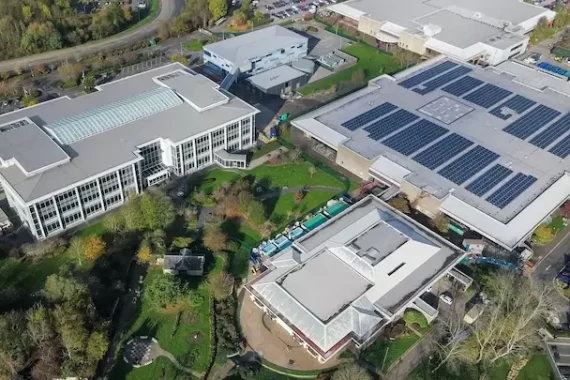
As a practical planning estimate, a 50kW commercial solar array may require roughly 250–350 square metres of usable roof area. However, gross roof area and usable solar area are not the same.
Air-conditioning equipment, skylights, vents, roof edges, access routes, shading and required clearances can reduce the area available for solar panels.
Commercial Solar Designed Around Your Property
A commercial solar system should be designed around how your business actually consumes electricity. Properties with strong daytime electricity demand can often use a significant proportion of solar generation directly on site.
Before recommending a 50kW solar system, the site’s roof, electrical infrastructure, consumption profile and future energy requirements should be considered together.
- Commercial electricity consumption profile
- Available and usable rooftop area
- Roof orientation and shading conditions
- Existing switchboard and electrical infrastructure
- Single-phase or three-phase supply
- Network connection and export requirements
- Future solar battery or EV charging requirements
Learn more about commercial solar installation for Australian businesses.
Which Businesses May Consider a 50kW Solar System?
A 50kW commercial solar system can be worth assessing where a business has substantial electricity consumption during daylight hours and enough suitable roof or ground area for the proposed array.
Warehouses
Large commercial roofs can provide substantial installation space where daytime electricity consumption supports the project.
Manufacturing
Factories and workshops operating machinery during solar-generation hours may be able to consume a meaningful share of solar production on site.
Retail Properties
Retail sites with daytime air conditioning, refrigeration, lighting and other electrical loads can be suitable for commercial solar assessment.
Office Buildings
Office buildings commonly consume electricity during the same daytime period in which rooftop solar produces energy.
Education & Childcare
Facilities operating primarily during daylight hours can assess commercial solar against their daytime electricity profile.
Commercial Properties
Multi-purpose commercial buildings can be assessed using interval electricity data, operating hours and available roof space.
Why Daytime Electricity Consumption Matters
The business case for commercial solar is strongly influenced by how much generated electricity can be consumed directly on site.
When solar generation replaces electricity that would otherwise have been purchased from the grid, the business can reduce grid consumption during those periods.
If a large proportion of generation is exported, the financial outcome can differ because export arrangements and rates may not have the same value as avoided retail electricity consumption.
- Review weekday and weekend electricity consumption
- Check electricity use during solar-generation hours
- Identify seasonal changes in business operations
- Review demand charges where relevant
- Understand potential network export limits
- Consider future equipment and operating-hour changes
- Include future EV charging or battery requirements
Is a 50kW Solar System Eligible for STCs?
A 50kW solar PV system can fall within Australia’s Small-scale Renewable Energy Scheme because eligible small-scale solar PV installations can include systems with rated capacity of no more than 100kW, subject to the applicable scheme conditions.
Eligibility is not determined by capacity alone. The system and installation must satisfy the relevant scheme requirements applying at the time of installation.
What Is Included in a 50kW Commercial Solar System?
Commercial Solar Panels
Solar modules convert sunlight into DC electricity. Panel efficiency, wattage, warranty and roof suitability are important commercial design considerations.
Commercial Inverter
The inverter converts DC electricity produced by the array into AC electricity suitable for use by the commercial electrical system.
Mounting System
Commercial mounting equipment secures the solar array to the roof or supporting structure according to the project design.
Electrical Protection
Appropriate isolation, protection, cabling and associated electrical equipment form part of a professionally designed installation.
System Monitoring
Monitoring can help the business review solar generation and identify changes in system performance over time.
Commercial Design
Panel layout, inverter configuration, electrical integration and network requirements should be coordinated for the individual property.
20kW vs 30kW vs 50kW Commercial Solar Systems
The right commercial solar capacity should follow the site’s electricity profile and physical constraints rather than simply selecting the largest system that fits on the roof.
| System Size | Key Planning Considerations | Potential Application |
|---|---|---|
| 20kW Solar System | Daytime demand, roof area, phase configuration and network conditions. | Smaller commercial premises. |
| 30kW Solar System | Higher daytime consumption and greater available roof area. | Medium commercial properties. |
| 50kW Solar System | Substantial site consumption, commercial roof area, electrical capacity and network requirements. | Larger businesses and commercial facilities. |
Can You Add Battery Storage to a 50kW Solar System?
Yes. Commercial battery storage can be assessed alongside a 50kW solar system where there is a clear operational reason for storing electricity.
A battery may be relevant where a business has substantial electricity consumption outside solar-generation hours, wants to investigate peak-demand management, requires selected backup capability or wants to increase the amount of solar electricity consumed on site.
Battery capacity should not be selected simply because the solar array is 50kW. Solar power capacity is measured in kilowatts, while battery energy storage is measured in kilowatt-hours. Battery sizing should therefore consider the site’s generation and electricity-consumption profile.
Explore our solar battery solutions for more information about energy-storage options.
How Much Can a 50kW Solar System Save a Business?
There is no single savings figure that applies to every 50kW commercial solar installation. Financial performance depends heavily on how the business currently purchases and consumes electricity.
- Annual solar generation at the property
- Percentage of generation consumed directly on site
- Retail electricity tariff
- Solar export tariff or export arrangement
- Operating days and business hours
- Seasonal electricity consumption
- Demand charges where applicable
- System degradation and maintenance
- Financing and overall project cost
For a more meaningful commercial assessment, recent electricity bills and interval consumption data can be compared with modelled solar generation to estimate how much grid electricity the proposed system could potentially offset.
What Is the Payback Period for a 50kW Solar System?
Commercial solar payback varies from one project to another. It is influenced by the installed system cost, available incentives, solar generation, self-consumption, electricity prices, business operating schedule and any financing costs.
A fixed payback period should therefore not be treated as universally applicable to every Australian business. A project-specific financial assessment provides a more useful estimate.
50kW Commercial Solar Installation Process
Energy Review
Review electricity bills, interval data, operating hours and future energy requirements.
Site Assessment
Assess roof space, access, shading, electrical infrastructure and relevant property conditions.
System Design
Develop an appropriate solar-panel layout, inverter configuration and commercial electrical design.
Network & Approvals
Address applicable connection, network and project approval requirements.
Installation
Install the solar array, inverter, mounting system and associated electrical equipment.
Commissioning
Test the system, complete commissioning requirements and configure available system monitoring.
50kW Solar System Installation Across Australia
Australian Design Solar assists commercial customers with solar enquiries across major Australian markets. Solar production, network requirements and site conditions vary by location, so each commercial project should be assessed individually.
Sydney & NSW
Commercial solar assessment for warehouses, offices, retail premises, workshops and other suitable NSW businesses.
Melbourne & Victoria
50kW commercial solar solutions designed around electricity demand, available roof area and site requirements.
Brisbane & Queensland
Commercial solar assessment for Queensland businesses looking to reduce daytime grid electricity consumption.
Adelaide & South Australia
Site-specific commercial solar design for South Australian businesses with suitable daytime electricity demand.
Canberra & ACT
Commercial rooftop solar options for suitable ACT businesses and commercial properties.
Other Australian Areas
Contact our team with your postcode and project details to discuss service availability and commercial solar requirements.
Explore Commercial Solar & Energy Solutions
50kW Solar System FAQs
How much does a 50kW solar system cost in Australia?
The installed price varies according to solar-panel and inverter selection, roof type, electrical infrastructure, access, network requirements and overall project complexity. A site-specific commercial quotation is more useful than relying on a generic package price.
How much electricity does a 50kW solar system produce per day?
A 50kW solar system may generate approximately 150–220kWh per day under suitable conditions. Actual production varies according to location, season, weather, orientation, shading, temperature and system losses.
How many panels are needed for a 50kW solar system?
Panel quantity depends on module wattage. Approximately 125 x 400W panels, around 114 x 440W panels or 100 x 500W panels can provide approximately 50kW of array capacity.
How much roof space is required for a 50kW solar system?
A practical planning estimate is approximately 250–350 square metres of usable roof area. Actual requirements depend on panel dimensions, layout, roof obstacles, access pathways and required clearances.
Is a 50kW solar system eligible for STCs?
A 50kW solar PV system can fall within Australia’s Small-scale Renewable Energy Scheme because it is below the applicable 100kW system-capacity threshold, subject to all other scheme, product and installation eligibility requirements.
Is a 50kW solar system suitable for a warehouse?
It can be suitable where a warehouse has enough usable roof area and electricity consumption that aligns well with solar-generation hours. The appropriate system size should be determined from the property’s actual electricity profile.
Can a 50kW solar system be installed with a battery?
Yes. Commercial battery storage can be assessed alongside a 50kW solar system. Battery capacity should be selected according to solar surplus, electricity consumption outside solar hours, operational objectives and backup requirements.
How long does a 50kW commercial solar system take to pay for itself?
There is no universal payback period. It depends on project cost, solar generation, electricity tariffs, daytime self-consumption, export value, operating schedule, available incentives and financing.
Can a 50kW solar system be expanded later?
Expansion may be possible, but it is best considered during the original system design. Available roof area, inverter capacity, electrical infrastructure and network requirements can all affect future expansion.
What types of businesses can use a 50kW solar system?
Potential applications include warehouses, factories, workshops, retail premises, offices, education facilities and other commercial properties with substantial daytime electricity demand and suitable installation space.
How do I get an accurate 50kW solar system quote?
Provide your business postcode, recent electricity bills, interval consumption data where available, operating hours and information about the premises. This information can be used to assess appropriate solar capacity, equipment and installation requirements.
Get a 50kW Commercial Solar Quote
Find out whether a 50kW solar system is appropriate for your business. Australian Design Solar can assess your electricity consumption, operating hours, available roof space and project requirements to prepare a site-specific commercial solar proposal.