Regular daytime operations
Share your opening hours and usage data. These help establish how solar generation could align with electricity consumed while the business is operating.

Australian Design Solar
Make better use of your commercial roof with solar designed around your business’s electricity demand.
Australian Design Solar helps businesses assess 30kW solar installations for offices, workshops, warehouses and other commercial premises. We consider your operating hours, electricity usage and site requirements before recommending a configuration.
Request a written proposal for your premises, with optional battery storage assessed separately.
Understand the system
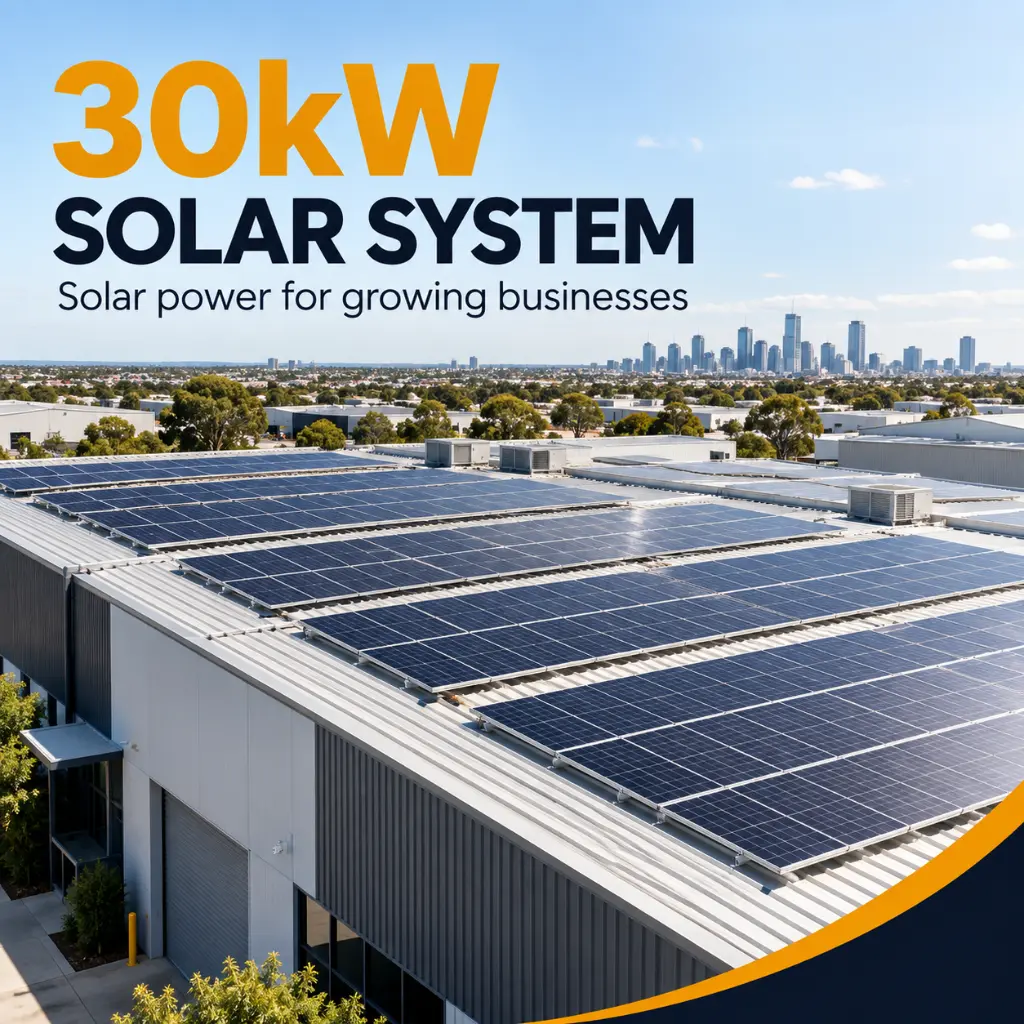
A 30kW solar array has approximately 30 kilowatts of combined panel capacity under rated test conditions. Its panels generate electricity during daylight hours, while inverter equipment converts that output for use at your premises.
Panel capacity and inverter capacity should be listed separately in your quote. A package described by its inverter size may contain a different total panel capacity.
Our team can help you compare the proposed configuration with the way your business uses electricity.
Match capacity to consumption
A large roof does not automatically mean you need a larger system. Assess electricity demand, available roof area and project objectives together.
Share your opening hours and usage data. These help establish how solar generation could align with electricity consumed while the business is operating.
Discuss roof condition, usable space, switchboards and site access. Identify further assessments needed before an installation can be confirmed.
Tell us about planned machinery, longer shifts, additional cooling or electric vehicle charging so these changes can inform the proposal.
Installation pricing
Australian Design Solar provides tailored quotations for 30kW projects. Your installed price depends on equipment selection and the work needed at your premises.
Ask for a complete scope so you can compare proposals using the same equipment and installation assumptions.
Confirm panel models, panel count, inverter specifications, monitoring features and applicable product warranties.
Roof access, mounting, cable routes, electrical upgrades and working arrangements can affect the final scope.
Clarify approval responsibilities, metering, export controls and any battery or backup equipment included.
Review GST treatment, any incentive assumptions, payment terms, provisional costs and exclusions in your written quotation.
Panel count explained
Divide the target array capacity by the individual panel wattage. These examples show configurations at or close to 30kW; they are not fixed package inclusions.
| Panel wattage | Number of panels | Array capacity |
|---|---|---|
| 440W | 68 | 29.92kW |
| 450W | 67 | 30.15kW |
| 500W | 60 | 30.00kW |
Final panel count depends on the selected model, roof layout and approved system configuration.
Use the dimensions of the proposed panels to assess the layout. For example, 60 panels occupying an assumed 2.2m² each would cover 132m² of panel surface.
This illustrative calculation is not a minimum roof-area requirement. Access, spacing, roof edges, obstructions and multiple roof sections must also be considered.
Generation estimates
Actual output changes with location, weather, season, shading and system design. Ask for estimated annual generation and a monthly breakdown for your proposed roof layout.
Compare that production with working-day and weekend consumption. Generation alone does not show how much electricity your business will use directly.
If a site assessment assumed a net daily yield of 4kWh per installed kW:
30kW × 4kWh/kW = 120kWh per day.
This is an arithmetic example using an assumed yield. It is not a production forecast or guarantee for your property.
Evaluate the business case
Bill savings can begin when an operating system reduces electricity purchases. Payback is the point at which accumulated net savings recover the initial investment.
Ask any financial estimate to explain its assumptions rather than relying on a fixed payback promise.
Connection planning
A 30kW project needs assessment of the supply arrangement, inverter configuration and local connection requirements. Do not assume your existing electrical setup can accept the proposed equipment without changes.
Permission to connect an inverter and permission to export electricity are separate considerations. Clarify both before the final design is agreed.
Solar with battery storage
Battery storage should address a specific requirement, such as using surplus solar during later operating hours. A 30kW solar array does not automatically require a 30kWh battery.
Discuss usable storage capacity, output power and compatibility with the proposed inverter. If backup is required, specify the intended circuits and operating limits.
Demand-charge management also needs a tariff and usage assessment; battery capacity alone cannot establish the benefit.
Explore solar systems with battery storageBackup requires suitable equipment and configuration. It should not be assumed to power the entire premises.
Your project journey
Provide your bills, business hours, postcode and details of existing solar or planned equipment.
Discuss roof layout, site assessments, equipment and the scope of connection work.
Confirm the quote, approvals, access and any planned electrical shutdowns before scheduling.
Keep equipment records, monitoring details where included, warranties and support contacts.
Australian Design Solar
We help businesses compare solar options with attention to equipment, site requirements and installation scope. Ask our team to explain the recommendation and any information needed to complete the assessment.
Learn more about us and why choose Australian Design Solar .
If 30kW is not the best match, discuss a smaller or larger installation based on site demand.
Review our Warranty Policy alongside the documents for your selected products.
Local project enquiries
Discuss your project in Sydney, Melbourne, Brisbane, Adelaide or Canberra. Send your postcode and site details to confirm availability and assessment requirements.
Sydney enquiries include Norwest, Bella Vista, Castle Hill, Baulkham Hills, Seven Hills, Blacktown, Parramatta, Rouse Hill and surrounding business areas.
Common questions
Pricing depends on equipment, roof access, electrical work and connection requirements. Request a tailored quote showing the full scope and total payable amount.
The count depends on panel wattage. For example, 60 × 500W panels total 30kW, while 68 × 440W panels total 29.92kW. Confirm the exact array capacity in your quote.
Request a site-specific annual estimate and monthly breakdown. Location, roof orientation, shading and weather affect production, so a fixed daily figure is not guaranteed.
Savings can begin once an operating system reduces grid purchases. Payback occurs later, when accumulated net savings recover the initial investment.
Access, working areas and any electrical shutdowns should be discussed before scheduling. Tell us about sensitive equipment, deliveries and preferred working times.
You can enquire, but identify the property owner and relevant decision-makers early. Confirm permissions and project arrangements before proceeding.
It may be possible, subject to equipment compatibility and installation requirements. Discuss future storage plans before selecting the initial inverter configuration.
Standard grid-connected solar normally shuts down during an outage. Backup requires suitable equipment and a configuration designed for the intended loads.
Complete the form near the top of this page or call 1300 85 1919. Have your postcode, electricity bills and business operating hours available for the discussion.
Start with your business needs
Speak with Australian Design Solar about your electricity demand, roof and project goals. Compare suitable options and request a clear installation quote.